Pages

.

Showing posts with label Cuisine: French. Show all posts

Holiday baking: Sliced Almond Christmas Cookies

French gingerbread / Christmas cookies / Piparkoogid / Viilupiparkoogid
From the recipe archives!

It's the time to bake various Christmas cookies again. While I'll certainly be making and baking and decorating a batch of these favourite Estonian piparkoogid ("pepper cakes"), then this year I have another recipe in mind as well. These sliced Christmas cookies with almonds found their way into my heart in the midst of the summer heatwave, as I was choosing and testing recipes for my Christmas cookbook. I had seen a recipe for "French gingebread cookies" in a Swedish food magazine that I liked, and that reminded me of Jules Destrooper's wonderful almond thins that I used to love. After some tweaking here and there (less sugar and less cloves, more almonds), I ended up with this great recipe.

I usually divide the dough into four equal portions and roll and wrap them individually. Then I bake one and place three in the freezer - I can then bake fresh and aromatic Christmas cookies whenever I feel like :)

Almond Gingerbread Cookies
(Viilupiparkoogid)
Makes a lot - about 4 large sheets

viilupiparkoogidNAMI

250 g butter
200 g caster sugar
140 g light baking syrup (about 100 ml)
420 g plain flour (700 ml)
1 Tbsp ground cinnamon
0.5 Tbsp ground cloves
0.5 Tbsp baking soda
100 g sliced almonds

Melt the butter in a saucepan. Add sugar and syrup, stir until combined. Remove from the heat and let cool completely.
Combine flour, cinnamon, cloves, baking soda and almonds in a bowl, then fold into the cool butter-sugar-syrup mixture. Stir until combined.
Divide the cookie dough into four equal parts, then form each one into a cylinder/sausage, about 4 cm in diameter. Wrap in clingfilm or baking paper and place into the fridge to rest. (Ideally for 24 hours).

To bake the cookies, cut each "sausage" into 3-4 mm (1/8th inch) slices, and place onto a parchment covered cookie sheet.
Bake in the middle of a preheated 200 C oven for 6 to 8 minutes, until golden brown.
Remove from the oven, let rest for a few minutes, then transfer onto a metal rack to cool completely.

French gingerbread / Christmas cookies / Piparkoogid / Viilupiparkoogid

This recipe was also included in my second cookbook, Jõulud kodus ("Christmas at Home"), published in Estonian in November 2011.
reade more... Résuméabuiyad

Smoked salmon and spinach quiche

Spinati-suitsulõhepirukas / Spinach and smoked salmon quiche

Some seven years ago, when my dear K. and I met for a long weekend date in Paris. One morning we had a late breakfast at Bread & Roses, a lovely deli-cafe near the Luxemburg gardens. I cannot recall exactly what else we had, but we definitely had a really lovely smoked salmon and spinach quiche. I even wrote about it back in 2006, after baking it in Edinburgh (yes, back then I was still living in the beautiful capital of Scotland, and K. and I were having a long-distance relationship. We had no idea what life had in store for us, and definitely didn't think we'd be happy parents to three little kids in 2013 :))

The quiche is still a favourite with us, always bringing back nice memories of those promising spring days in Paris. I've modified the recipe a little over the years, and here's the adapted recipe for you, my dear readers.

Smoked salmon and spinach quiche
(Spinati-suitsulõhepirukas)
Serves six

NOTE that an American cup is 240 ml, an ounce is about 28 grams and 100 grams of butter is 7 Tbsp - in case you need to convert the measurements! 

IMG_5716.jpg

All-butter crust:
180 g all-purpose flour (300 ml)
100 g cold butter, cubed
a pinch of salt
2-3 Tbsp cold water

(Or use your favourite pâte brisée/shortcrust pastry recipe; you'll need about 300 grams).

Filling:
150 g cold-smoked salmon or trout, chopped
300 to 450 g frozen chopped spinach, defrosted and squeezed dry
300 to 400 ml double cream/whipping cream/heavy cream
3 large eggs
100 g cheese, shredded
salt and freshly ground black pepper

Start by making the pie crustIf using your hands, then rub the butter into the flour (with salt added) until the mixture resembles fine breadcrumbs. If using a food processor, then place flour and salt into a food processor and pulse until combined. Add the cold butter and pulse until you have a mixture that resembles a coarse meal.

Add a spoonful or two of cold water and pulse again, until the mixture just clumps together. Mix until the the dough forms a ball. Press the dough into a greased or non-stick springform pan, 24 cm (9'') or 26 cm (10'') in diameter, going slightly higher up on the sides when using the smaller cake pan.

Place the pan into fridge or freezer for about 30 minutes.
Meanwhile, preheat the oven to 200 C (400 F). 

Bake the pie shell in the middle of the oven for about 15-20 minutes, until golden and beginning to pull away from the sides of the pan. 

For the filling, whisk together the cream, eggs, salt and pepper. Add the chopped fish, spinach and shredded cheese. Spoon the filling into the partially baked tart shell and continue baking for about 30-40 minutes, until the filling is set and golden brown. 

Cut into wedges and serve either hot, at room temperature or cold. A nice green salad on the side would be nice. 

Smoked salmon and spinach quiche. Suitsulõhe-spinatipirukas.
reade more... Résuméabuiyad

Braised rabbit with mustard (lapin à la moutarde)

Sinepine küülik / Mustard and rabbit stew
Photo by Juta Kübarsepp for the November 2012 issue of Kodu ja Aed magazine.

It's snowing outside, and once again I'm craving something belly- and heart-warming. This braised rabbit with mustard sauce (lapin à la moutarde) hits the spot. Rabbit has become more easily available here in Estonia for an average shopper (read: you can get it vacuum-packed in your local supermarket), and this rabbit stew with a creamy mustard sauce is an excellent way of cooking rabbit.

The recipe is French-inspired and adapted from Anthony Demetre, the chef patron at the London restaurants Arbutus, Wild Honey and Les Deux Salons; more specifically, from his book Today's special: A new take on bistro food - Recipes from Arbutus and Wild Honey. Demetre uses rabbit legs, but for a home cook, using a whole rabbit makes much more sense - and is much more economical, of course.

It's my favourite way of cooking and serving rabbit - I included the recipe in my first cookbook, as well as in the November 2012 issue of Kodu ja Aed magazine. You can braise this one on the stovepot or bake in the oven - the choice is yours.

Braised rabbit with mustard
(Sinepine küülikuhautis)
Serves four to six
Mustard Rabbit / Küülik sinepikastmes

1 rabbit
sea salt and freshly ground black pepper

75 g butter

75 ml white wine vinegar (5 Tbsp)
3 Tbsp good Dijon mustard
500 ml (2 cups) hot chicken stock
200 ml double or whipping or heavy cream
1 Tbsp dried oregano
1 tsp smoked paprika powder (pimentón de la Vera)
1 tsp finely chopped fresh rosemary
5 garlic cloves
2 bay leaves

If braising the rabbit in the oven, then pre-heat the oven to 200 C/400 F.

Cut the rabbit into serving pieces (here's a photo of me tackling another rabbit, I usually end up with two shoulders, two legs, two belly flap pieces, 2 saddles; I throw the rib cage into the stew as well to give extra flavour, but I don't eat it; here's Hank Shaw's very detailed step-by-step guide, which I find a wee bit over-complicated, but perhaps the rabbits here and there are somewhat different :); and finally, here's Saveur's guide).

Season the meat with salt and pepper.

Take a heavy saucepan or Dutch oven or casserole dish. Melt the butter, then brown the meat pieces on all sides (you'll need to do that in 2-3 instalments probably). Remove the browned pieces and put aside.

Pour the wine vinegar into the saucepan, bring to the boil and reduce by half. Add the rest of the ingredients, bring into the boil again. Season to taste with salt and pepper, then return the browned rabbit pieces into the saucepan again.

Once again, bring into the boil, cover tightly with the lid and transfer into the pre-heated oven. Cook for about 1,5 hours, until the meat falls off the bone.

(If you opt for stove-top braising, then simmer over moderately low heat, covered, until the meat falls off the bone).

Serve with seasonal vegetables.

Similar recipes:
Hank Shaw's rabbit in mustard sauce @ Simply Recipes
Raymond Blanc's braised rabbit with mustard @ BBC Food
Rabbit cooked with Dijon mustard @ Saveur
Rabbit with mustard @ Gourmet Traveller WINE
Mustard rabbit @ The Evening Hérault
Rabbit in mustard sauce @ French cooking for Dummies
Rabbit in mustard cream @ Lindaraxa

reade more... Résuméabuiyad

Oxtail ragout with celeriac mash

Veisesaba / Oxtail / Härjasaba / Lehmasaba

Oxtail - isn't it beautiful? I admit that I blatantly nicked the idea for today's post from the wonderful Jeanne in London, who wrote about a 20-hour sous vide oxtail stew in her award-winning blog, Cook Sister! Here's my oxtail story.

Nightview / Öine vaade Albarracinile
Albarracín at night, March 2008

I still remember my first encounter with oxtail - on a plate, I mean. My dear K. and I were travelling in Spain in March 2008, visiting the lovely Ximena of the Lobstersquad fame in Madrid, and visiting some other off-the-beaten-track cities that Ximena and her also very lovely husband J. had suggested. One late afternoon we arrived in the picturesque Albarracín in Aragon (yep, on the lands of the medieval Kingdom of Aragón). After checking into our hotel for the night, we wandered on the streets of Albaraccín, looking for a tiny restaurant called Rincón del Chorro. Somebody somewhere had recommended it, you see. The night was already dark, but we were obviously too early for dinner, as all we found was a locked door. We returned an hour later, to find a small but busy restaurant. The menu wasn't long - I opted for the pickled partridge (a local speciality, I was told), K. ordered the rabo del toro or oxtail.

Rabo de Toro / Oxtail Stew / Härjasabahautis e. veisesabahautis e. lehmasabahautis

Both were brought to the table pretty quickly. While the partridge was lovely, the oxtail was wonderful and although the idea of cooking it myself seemed a wee bit daunting initially, I've become a huge oxtail convert over the years and cook this particular cut of beef regularly.

My favourite oxtail dish takes slightly less time to cook than Jeanne's and as there's definitely no sous-vide machine in my kitchen, it can be cooked in a simple stovetop saucepan. But I guarantee it'll be just as delicious ;) The inspiration for the dish is from a blog written by an Estonian restaurateur, Mme Randrüüt - see here. It's an interpretation of the French classic, mijotée de queue de boeuf et purée de céleri rave or stewed oxtail with celeriac pureé. If you haven't cooked oxtail before, then slowly cooked oxtail has the most wonderful sweet and meaty flavour, which is pretty much universally liked. While we happily gnaw away on the slowly cooked oxtail pieces (there's a link to another oxtail stew recipe here on Nami-Nami at the bottom of this post), it can be intimidating to somebody who's new to oxtail - or if you're wanting to serve oxtail in a slightly more elegant manner. This oxtail ragout is the perfect solution then.

Oxtail / Härjasaba e. veisesaba

In Estonia I usually get my oxtail cut into chunks and packed neatly on a tray. Very convenient, even if it is only sold in one major supermarket and only on certain days, so one has to pre-plan carefully. If you have a friendly butcher at your favourite market, you can obviously order some whenever you need it.

Oxtail ragout with celeriac mash
(Veisesabaraguu)
Serves two to three (can be easily doubled)

Oxtail ragout with celeriac mash / Veisesabaraguu selleripüreega

1 kg oxtail pieces
2-3 Tbsp oil
500 ml (2 cups) boiling water
few fresh parsley sprigs
few fresh thyme sprigs
1 bay leaf
3-4 whole black peppercorns
3-4 whole allspice berries
salt, to taste

Season the oxtail pieces with salt.
Heat oil in a heavy saucepan, sauté the oxtail pieces until dark golden brown on all sides.
Add the water, herbs and seasonings. Bring into a boil, then reduce heat and cover the saucepan. Simmer gently for about 3-4 hours until meat falls off the bones easily.
Remove from the heat, cool. Remove the meat off the bones, discard the bones and return the meat into the stew.

(This can be done a day in advance). 

Skim the excess fat from the top of the stew. Re-heat the stew and simmer gently for another hour or two, until the stew has thickened. Taste for seasoning.

Serve with a celeriac/root celery mash - prepare like your regular potato mash, just use root celery instead.

Looking for more oxtail inspiration? Here are some recipes:

Papardelle with oxtail ragu by Skye Gyngell
Oxtail ragout with papardelle by Sammy and Bella (My Kitchen Rules)
Oxtail braised in dark beer by Nami-Nami
Coda alla vaccinaria by Food Lover's Odyssey
Glazed oxtails by Simply Recipes
Korean braised oxtail by Kitchen Wench
Alsatian oxtail stew by Choosy Beggars

reade more... Résuméabuiyad

Béarnaise sauce, grilled steak and home-made chunky potato chips

Steak, chunky chips and Béarnaise sauce / Minutipihv, Bearni kaste ja friikartulid

Playing around with food is all fine, but sometimes I want a good old classic dish. Take the Béarnaise sauce. I first encountered back in Denmark in 1992/1993 - my host mum would make it regularly and serve it with grilled steak. It came in a powdered form from a packet, but to my 18-year-old tastebuds it tasted just fine and I instantly fell for the tarragon-infused creamy sauce. A good steak and tarragon-enhanced sauce Béarnaise is truly a match made in heaven! I wouldn't touch the Béarnaise made from a powder anymore, but I still love the sauce.

Note that the sauce has nothing to do with the Swiss capital, Bern. It gets its name from the birth-place of d'Artagnan (the one in "The Three Musketeers"), Béarn province, in South-Western France :)

The recipe below is based on Paul Gayler's recipe in Jill Norman's excellent The Cook's Book. Paul Gayler suggests using clarified butter to make this sauce (as well as it's "mother sauce", Hollandaise), but I am happy enough with using just melted butter myself.

What's your relationship to Sauce Béarnaise? Love it or hate it?

Béarnaise Sauce
(Béarni kaste)
Serves 4 to 6 (makes about 600 ml)

2 Tbsp white vine vinegar
2 Tbsp water
1 tsp white peppercorns, lightly crushed
2 Tbsp roughly chopped fresh tarragon or 2 tsp dried tarragon
2 small shallots, chopped
4 large egg yolks
250 g unsalted butter, melted
1 Tbsp fresh tarragon, chopped
1 Tbsp fresh chervil, chopped
sea salt

Place the vinegar, water, peppercorns, tarragon and shallots in a small pan. Bring to the boil, then lower the heat and simmer for about 1-2 minutes, until reduced to about 2,5 Tbsp. Remove from the heat and leave to infuse and cool.
Strain the liquid into a heatproof bowl. Add the egg yolks and whisk until combined
Set the bowl over a pan of simmering water (bain-marie), the base of the bowl should not touch the hot water, but be just above it. Whisk the mixture for 5-6 minutes, until it thickens and is creamy and smooth in texture.
Remove the bowl and place onto a dampened kitchen towel (this helps to keep the bowl in place). Slowly pour in the melted butter in a thin stream, whisking vigorously all the time, until the sauce is thick and glossy.
Add the chopped tarragon and chervil, season to taste with sea salt and serve at once.
reade more... Résuméabuiyad

Maison Pic, Valance, France (Restaurant review)

Sorry about the hiatus. We've just spent 10 days travelling (and eating!) in Normandie and Bretagne with our little family. While we unpack our bags and upload the photos, I'll share some photos from our last trip to France in August 2009. Back then we were still three - our daughter just 7,5 months old - and we had a chance to eat in two 3-star restaurants. Excellent meals both, and I'll start with Anne-Sophie Pic's restaurant, where we had a lunch, a full tasting menu and breakfast.

Anne-Sophie Pic (born in 1969) is the head chef at La Maison Pic in Valance, France. She's a third-generation la chef cuisinier of the family restaurant, which was previously run by her dad and grand-dad. She earned the third Michelin star already at the age of 37, and is one of the only two female chefs in France and of female chefs in the world to win the accolade. Earlier this year she was also named the World's Best Female Chef (you can read an excellent synopsis of her culinary credentials and history here). Even before that last award, I was extremely excited about the chance to have lunch and dinner at her restaurant. Valance isn't on most tourist routes, but as we were driving down from Lyon to our friends' wedding in Sauzet further South, it was conveniently on the way. Lucky me :)

Anne-Sophie with her dad and grandfather:
Anne-Sophie Pic with her dad and granddad

Upon arrival we had some nibbles in the courtyard, while our room was being prepared. From left to right: tomato and lemon macaroon, basil and ricotta sphere, peanut marshmallow, foie gras and apple:
Amuse bouche

Maison Pic

That was a great alternative to the more usual nut selection:
Nut bowls

After settling into our spacious room, we headed for lunch at Bistrot Le 7. The name Le 7 is an homage to Route Nationale 7, a famous motorway connecting Paris and Côte d’Azur (The French Wench has written more about it).
Bistrot Le 7

Le tarte fine croustillante de saumon salma, légumes croquants aux aromates (for me):
Bistrot Le 7, Valence: le tarte fine croustillante de saumon salma, légumes croquants aux aromates

K. was very pleased with his tomato starter - Les tomates de variétés anciennes, crémeux de mozzarella di bufala - one of the reasons why he's so supportive of my grow-as-many-tomato-varieties-as-you-can hobby:
Bistrot Le 7, Valence: Les tomates de variétés anciennes, crémeux de mozzarella di bufala

For the main course, I went for the veal dish - Le poitrine de veau, confite aux aromates, etuvée fondante de fenouils et poivrons rouges:
Bistrot Le 7, Valence: le poitrine de veau, confite aux aromates, etuvée fondante de fenouils et poivrons rouges

K. chose the cod - Le cabillaud, cuit sur la peau a la'huile d'olive,fondant de carottes des sables a la fleur de thym:
Bistrot Le 7, Valence: le cabillaud, cuit sur la peau a la'huile d'olive,fondant de carottes des sables a la fleur de thym

For dessert, I opted for the classic strawberry-basil combination - Le fraisier version 2009; biscuit pistache, sorbet basilic (for me):
Bistrot Le 7, Valence: Le fraisier version 2009, biscuit pistache, sorbet basilic

K. opted for the cheese plate:
Bistrot Le 7, Valence: fromage

We were very pleased with our lunch - it was flavoursome and very pleasing to the eye.

We had a pretty late dinner. I apologise for the quality of the photos - there wasn't any natural light, of course, and we didn't want to use the flash. We opted for the News Menu (or Menu Actualités), which was the one of the tasting menues on offer.


I loved the personal touches on the cutlery and dishes (see also the amuse bouche plate above):
News Menu @ Maison Pic

News Menu @ Maison Pic

Summer truffle:
News Menu @ Maison Pic

Veal sweetbread:
News Menu @ Maison Pic

Foie gras:
News Menu @ Maison Pic

Lobster tail in a spicy broth:
News Menu @ Maison Pic

I loved the cucumber crocant that accompanied this subtly flavoured fish:
News Menu @ Maison Pic

Rinse-bouche: coffee granita with Limoncello foam:
News Menu @ Maison Pic

A beautiful cheese board:
News Menu @ Maison Pic

Mignardises:
News Menu @ Maison Pic

A very pretty dessert with raspberry sorbet:
News Menu @ Maison Pic

Overall the food was very tasty. We appreciated that Anne-Sophie Pic came to personally greet us at the end of the meal and speak about the difficulties of travelling and dining out with a baby :) She had seen our little daughter, sleeping at the Reception (we had asked about being allowed into the restaurant with the baby and they assured us it's fine and that they're happy to babysit the baby during our meal - which the kind receptionists ended up doing. Very thoughtful).

However, when looking at the visual side of the meal, it was all quite pared down and beige-brown (NB! I'm talking about dinner here!). We had another 3-star meal during our trip (@ Régis Marcon's restaurant), which was visually much more entertaining and impressive (our only other comparison is with lunch @ El Bulli in 2008). The only real 'eye candy' was the dessert.

Breakfast - croissants and other pastries, yoghurt verrines, some fresh fruit:
Breakfast @ Maison Pic, Valence, France

Breakfast Breakfast @ Maison Pic, Valence, France@ Maison Pic

Breakfast @ Maison Pic, Valence, France

Breakfast @ Maison Pic, Valence, France

Oh, the hotel gave our daughter a little present - a green soft frog with Maison Pic's shawl. She loved (eating) it :)
Breakfast @ Maison Pic, Valence, France

Here's me, my daughter and the Chef, just before we checked out:
Me, Nora Adeele & Anne-Sophie Pic

Would I go again? Yes, definitely - both for the food, for the hotel, and for the beautiful chef :)
reade more... Résuméabuiyad

French tomato tart with a lot of mustard

French tomato and mustard tart / Prantsuse sinepine tomatipirukas

I guess you gathered from yesterday's tomato posting that we're swamped with tomatoes this year. That means lots of tomato dishes - like this flavorsome tomato salad, for instance. Here's another flavoursome tomato dish - a mustardy French tomato tart that's excellent with some peppery green salad leaves. Choose tomato variety with few seeds, as then you don't have to deseed or drain them first and save some valuable time for yourself.

French tomato tart
(Sinepine tomatipirukas)
Serves six to eight

Crust:
200 g plain flour
pinch of salt
100 g butter
1 egg

Topping:
3 Tbsp sour cream, creme fraiche or double cream
3 Tbsp Dijon mustard
5 to 6 medium sized tomatoes
sea salt flakes and freshly ground black pepper
fresh thyme or oregano
extra virgin olive oil, to drizzle

First make the tart crust. Mix flour, salt and cold cubed butter in the food processor until crumbly, then add the egg and give it a few turns. Press into a dough ball with your hands, then use your fingers to line a 26 cm pie dish with the dough. Pierce the bottom with a fork in a couple of places, then place into the fridge for half and hour.
Bake the cool crust in a preheated 200 C oven for about 15 minutes (you can also blind-bake, but I didn't bother with that).
Combine mustard and cream, then spread onto the base of the pre-baked pie crust.
Cut the tomatoes, crosswise, into 5 mm slices, layer nicely onto the mustard layer. Season with salt and pepper.
Bake in the pre-heated 200 C oven for about 40 minutes, until tomatoes are nicely roasted and coloured.
Drizzle with some olive oil, sprinkle fresh thyme or oregano leaves on top and serve either hot or cold.
reade more... Résuméabuiyad

Poulet aux quarante gousses d’áil or chicken with 40 cloves of garlic


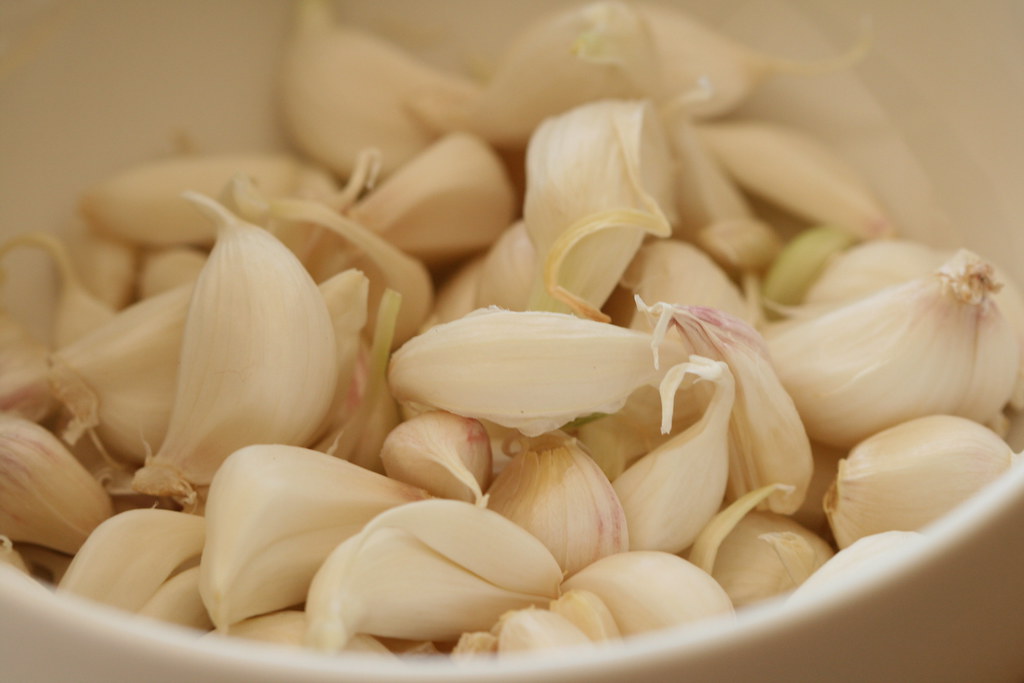
Here's a dish that I made several times during last year - and hope to make again as soon as the fresh, new season's garlic appears on the market stalls in a couple of months. It's a dish that I had been intrigued by for ages - imagine, 40 whole garlic cloves to season just one chicken! - and when I finally made it, I fell instantly in love with it. When researching the dish, I came across several and very different versions. After making it several times, I've settled for this minimalist one. Just chicken, olive oil, lots of garlic and some salt'n'pepper. If you like your chicken with crispy skin and sticky, browned bits, then this version isn't perhaps for you, though you can always brown the chicken on a frying pan first and give it a short blast under the grill at the end.

The dish originates in Southern France, Provence, which is famed for its excellent olive oil and large, rosy-tinged garlic cloves. I love making this with young fresh garlic (see photo here), but it works with any garlic. Although the amount of garlic sounds somewhat over the top, then trust me and don't be tempted to choose some tiny garlic cloves. The bigger, the better here. Also, I'm sure the French would use a good extra virgin olive oil here, but if price is the issue, then any good olive oil works here.

Chicken with 40 cloves of garlic
(Kana 40 küüslauguküünega)
Serves 6

Poulet aux quarante gousses d'ail / Chicken with 40 cloves of garlic / Kana 40 küüslauguküünega

1 whole chicken, preferably free-range (about 1,5 kg)
salt and freshly ground black pepper
40 large garlic cloves (from 4-5 whole heads of garlic)
250 ml (1 cup) olive oil
fresh herbs of your choice (rosemary, sage, thyme, bay leaves)

First, prep your garlic cloves. When making this with fresh and young garlic cloves, then there's no need to peel them. During winter you should first blanch your garlic cloves in boiling water for 1 minute, then drain and remove the softened papery skins.
Using a kitchen paper, pat the chicken dry. Season generously with salt and pepper, both inside and out. Place the chicken, breast-side up, into a Dutch oven or heavy casserole dish where the chicken fits snugly (the better the fit, the less oil you need).
Push the garlic cloves and herbs around the chicken, pressing them down between the chicken and the dish.
Pour over the olive oil - check that all the garlic cloves are covered with oil.
Cover the saucepan and place into a preheated 180 C/360 F oven. Bake for 1 hour and 15-30 minutes, until the chicken is cooked.

Poulet aux quarante gousses d'ail / Chicken with 40 cloves of garlic / Kana 40 küüslauguküünega

To serve, carve the chicken into suitably large chunks. Serve with fresh green salad leaves and some wholemeal bread to mop up the delicious garlicky juices. Don't forget the softened and mellowed garlic cloves - these are the extra bonus of the dish. I love pressing them onto piece of bread.

* You can use the leftover garlicky olive oil to dress up a salad or serve as a seasoned frying oil during the next few days.
reade more... Résuméabuiyad

Fig and Goat Cheese Clafoutis


I'm still taking full advantage of the availability of good quality fresh figs at the markets at the moment. The figs are from Turkey, with dark purplish skin and beautifully pink insides. I've got no idea what's the actualy name of the specific fig variety. They're a bit too plump and round for Black Mission. Perhaps Brown Turkey?

One of the fig recipes I had bookmarked already three years ago was Melissa's Fig and Goat Cheese Clafoutis, and I was excited to finally try this at home. I can testify that it's a wonderful clafoutis recipe - the tart creamy goat cheese indeed made it taste a bit like cheesecake, it had a lovely clafoutis conistency, and it looked absolutely amazing. We enjoyed it when still slightly warm, and I think that's when the clafoutis is at its best, but it tasted also good when completely cool.

Do try it, if you've got a chance.


See here for the Estonian recipe: Viigimarjavorm kitsejuustuga.
reade more... Résuméabuiyad

Rustic Apricot Tart


We ate quite a few of those delicious Bergeron apricots while in France, and back home, I was craving for more. So I made this ridiculously easy rustic apricot tart. This is the only free-form tart I've ever made, but I've made it several times, so it's quite a favourite. Once you've got the pastry out of the way, it's really just the matter of piling the fruit on top of it.

Note that this is just as lovely, if not better, on the following day. The apricot might look slightly worse for wear, but the pastry improves from some standing, as the moisture in the air makes it nicely crumbly and soft.

Delicious with either a scoop of vanilla ice cream or a dollop of whipped cream.

Rustic Apricot Tart
(Aprikoosipirukas)
Serves six to eight


Pastry:
150 g unsalted butter, at room temperature
100 g caster sugar
1 large egg
a pinch of salt
250 g all purpose/plain flour
0.5 tsp baking powder

If using a food processor, place sugar, salt, baking powder and flour in the processor and blitz to combine. Add butter and process until fine crumbs form. Add the egg, pulse couple of times until the mixture looks moist. Take out of the processor and knead with your hands until combined. Press into a flat disk.
Place the pastry on a baking sheet covered with parchment paper and a light dusting of flour. Roll out into something reminding you of a circle, about 5-6 mm (1/3 inch) thick.

Topping:
10-12 large apricots, stoned
100 ml all-purpose/plain flour (just under a cup)
100 ml caster sugar (just under a cup)
100 ml ground almonds/almond meal (just under a cup)

Mix flour, sugar and ground almonds until combined, pour into the middle of the pastry circle, leaving about 5 cm (2 inches) clean border around it.
Now layer the apricots of top, making about three layers, each one smaller than the one just under it.
With the help of the baking paper and floured hands, fold the edges of the pastry over the apricots (see the picture below).
Bake in a preheated 200 C / 400 F oven for about 20-25 minutes, until the apricots are soft and the pastry golden brown and cooked.
Remove from the oven, let cool a little and then gently transfer onto a cake plate.


reade more... Résuméabuiyad