Pages

.

Showing posts with label Cuisine: Spanish. Show all posts

Chickpeas with chorizo (Garbanzos y chorizo)

Kikerherne-tomatihautis chorizoga. Garbanzos y chorizo. Chickpeas with chorizo

Chickpeas (or garbanzo beans, as they're known in the US), that excellent store-cupboard ingredient that helps one to make many an excellent meal. A filling chickpea and tuna salad with smoked paprika powder. A healthy vegetarian side dish consisting of chickpeas and pomegranate molasses. A quick tortilla wrap with chickpeas and tuna. A chickpea and tomato soup with smoked paprika.  A chickpea and tomato soup with Moroccan spices. A quick hummus with beets. Or a quick hummus with wild garlic, come ramp or ramson season. Or a quick hummus with harissa paste, if you want something a wee bit spicier.

I always keep some in the cupboard, as they are indeed an excellent stand-by.

Chickpeas and smoked paprika powder (pimentón) is a match made in heaven, and this is utilised in this wonderful Spanish creation, garbanzos y chorizo. No pimentón or smoked paprika powder - pimentón de la Vera is considered the best - is needed, but you need a good-quality Spanish cooking chorizo that is seasoned with pimentón to start with. I came across a locally-made chorizo sausage last weekend - produced by Liivimaa Lihaveis - and decided to try an old favourite chorizo-and-chickpea (or chorizo-and-garbanzo) dish of mine*, and see, if the locally produced chorizo stands up to the proper Spanish one.

It did, I'm happy to admit.

Chickpeas with chorizo
(Kikerherned chorizo-vorstiga)
Serves four to six

 Kikerherne-tomatihautis chorizoga. Garbanzos y chorizo. Chickpeas with chorizo

1 Tbsp olive oil
1 large onion
1 red or yellow bell pepper
300 g cooking chorizo
400 g canned chopped tomatoes
800 g canned chickpeas (that's 2 regular cans)
about a cup of water
salt and freshly ground black pepper
fresh parsley, finely chopped

Peel the onion, halve and cut into thin slices. Halve and deseed the pepper, then cut into thin strips. Rinse and drain the chickpeas. Cut the chorizo into thin slices.

Heat the oil in a heavy saucepan or a large sauté pan. Add the onion and pepper and a sprinkle of salt and sauté over moderate heat for about 5 minutes, stirring every now and then.

Increase the heat, add the chorizo and fry for another few minutes, until the chorizo is slightly browned.

Add the chopped tomatoes, then pour about a cup of water into the tomato can, give it a quick swirl and pour into the pan. Add the chickpeas. Bring into a simmer, reduce heat to medium, cover and simmer gently for about 20 minutes.

Season to taste with salt and pepper. Sprinkle some herbs on top and serve with some crusty bread and a fresh green salad.

NOTE: This reheats well (you can add some water, if too dry), and it also tastes great when cold. 

 Kikerherne-tomatihautis chorizoga. Garbanzos y chorizo. Chickpeas with chorizo

* This dish is indeed a regular in our kitchen - I discovered this photo from August 2011 and this photo from April 2009 as well this one from April 2008 in Flickr :)

Similar recipes in other foodblogs:
In my Life (very similar to mine)
Morsels & Musings by Anna
Lindaraxa
Spanish Recipes pic by pic
Flanboyant Eats (much soupier version)

reade more... Résuméabuiyad

Grilled mackerel with potato and chorizo hash

Grilled mackerel with potato and chorizo hash / Grillitud makrell chorizo-kartuipadjal

Doesn't this look like something wonderfully light and spring-like? We've had couple of beautifully sunny days here in Estonia recently and I do believe now that this looooong and greyish winter will end, eventually.

Here's a simple lunch or dinner idea, using new potatoes, cooking chorizo (you can choose a spicy or milder one, it's up to you) and fresh mackerel. Flavoursome and filling!

Grilled mackerel with potato and chorizo hash
(Grillitud makrell chorizo-kartulipadjal)
Adapted from DeliciousMagazine.co.uk
Serves 4

500 g new potatoes, skin on
2 whole mackerels, filleted into 4 either by you or your fishmonger
2 Tbsp olive oil
juice of 1 lemon
1 garlic clove, crushed
a small bunch of flat-leaf parsley, roughly chopped
100-150 g cooking chorizo, cut into smaller chunks
salt and black pepper

Wash the potatoes thoroughly, then parboil in salted water until just tender. Drain and cool slightly.

Put the fish fillets into a shallow dish. Mix together the olive oil, lemon juice, crushed garlic, chopped parsley. Pour over the fish, then season generously with salt and pepper.

Grilled mackerel with potato and chorizo hash / Grillitud makrell chorizo-kartuipadjal

Peel the cooled potatoes, chop into smaller pieces.

Pre-heat the grill to high.

Prepare the potato and chorizo hash. Heat a large frying pan and cook the chopped chorizo over a high heat for about 2 minutes or until the oil starts to run. Add the chopped potatoes and cook for another 8-10 minutes, stirring every now and then, until the chorizo and potatoes are golden and crisp.

When the potatoes and chorizo are cooking, lift the mackerel fillets from the marinade. Place onto a grill rack and grill for 7-8 minutes, until the skin is golden and the flesh is cooked through.

To serve, spoon the potato and chorizo onto warmed plates, place the fish fillets on top, drizzle with some herb oil and serve immediately.

Grilled mackerel with potato and chorizo hash / Grillitud makrell chorizo-kartuipadjal
reade more... Résuméabuiyad

The best ever marinated olives (aceitunas aliñadas)

Marinated olives / Marineeritud oliivid

Well, I don't actually know if that title holds true, but when I made these olives recently, then my dear K stated that these are better than anything he's ever had before (read: shop-bought marinated olives). I loved them, too.

I had few friends over for a tapas night recently, and wanted to serve aceitunas aliñadas. I browsed tens of recipes for Spanish-style marinated olives, and finally came up with this version. I had run out of sherry vinegar, so used a mixture of Spanish red wine vinegar and some dry sherry instead, but feel free to use sherry vinegar instead. As far as the olives are concerned, try to find Spanish ones that are unstoned - these have much more flavour compared to the stoned olives. I used Spanish hojiblanca olives, but arbequina, sevillano, manzanilla (f. ex. Campo Real), arauco would all work well, too.

These last for a week in a fridge, if not longer.


PS If you've got a favourite marinated olives recipe, I'd love to hear about it! Feel free to leave a link to your recipe in the comments section.

Marinated olives, Spanish style
(Marineeritud oliivid)
Serves four to six as part of a tapas table

about 200-250 g olives (in brine, drained weight)
1 Tbsp Spanish extra virgin olive oil
1 Tbsp sherry vinegar (or red wine viner + 1 Tbsp sherry)
1 tsp coriander seeds, crushed in a mortar
1 thyme sprig, leaves only
1 rosemary sprig, leaves only
0.5 tsp dried red chilly flakes
1 or 2 garlic cloves, peeled and thinly sliced

Place the drained olives into a bowl, add the rest of the ingredients and stir.
Leave to macerate for at least couple of hours before serving.
reade more... Résuméabuiyad

Meatless Monday: Chickpea and Tomato Soup with Pimentón

Chickpea, pimentón and tomato soup / Tomati-kikerhernesupp, kergelt suitsune

I needed to look up some Portuguese recipes for a friend last weekend and obviously I turned to the very helpful Leite's Culinaria website. I did find the recipes I was looking for, plus a lot more. One of them was this simple, yet delicious soup recipe, originally from Tamasin Day-Lewis's book "Supper for a Song: Creative Comfort Food for the Resourceful Cook". I've adapted the recipe a little to suit our tastes, and we'll be definitely making this again. Puréeing some of the chickpeas/garbanzos to thicken the soup was a neat idea, and you can add more or less pimentón (aka smoked paprika) depending on the freshness and strength of your paprika powder.

While it's filling, it's also gluten-free and vegan, so perfect recipe for a Meatless Monday.

Chickpea and Tomato Soup with Smoked Paprika
(Kikerherne-tomatisupp, kergelt suitsune)
Serves four

1 Tbsp extra virgin olive oil
1 red onion, finely chopped
3 garlic cloves, finely chopped
2 celery sticks, chopped
2 Tbsp chopped fresh rosemary
400 g can tinned chickpeas/garbanzo beans, drained
1 tsp Pimentón de la Vera (smoked paprika)
2 bay leaves
1 Tbsp tomato paste
400 g can chopped tomatoes
1 litre of hot vegetable stock/bouillon
sea salt and freshly ground black pepper
some parsley leaves, to serve

Heat olive oil in a large saucepan. Add the onion, garlic, celery and rosemary and fry for a few minutes, until the aromatics are beginning to soften.
Add the chickpeas, smoked paprika, bay leaves, tomato paste and chopped tomatoes. Give it a stir and bring into a boil.
Add the stock, season with salt and pepper and bring into a boil again. Then reduce the heat, cover and simmer for about 10-15 minutes.
Remove the bay leaves.
Using a hand-held/immersion blender, purée some of the soup, leaving some of the chickpeas whole.
Divide between warmed soup bowls, garnish with parsley and serve.
reade more... Résuméabuiyad

Dulce de Membrillo, 2010

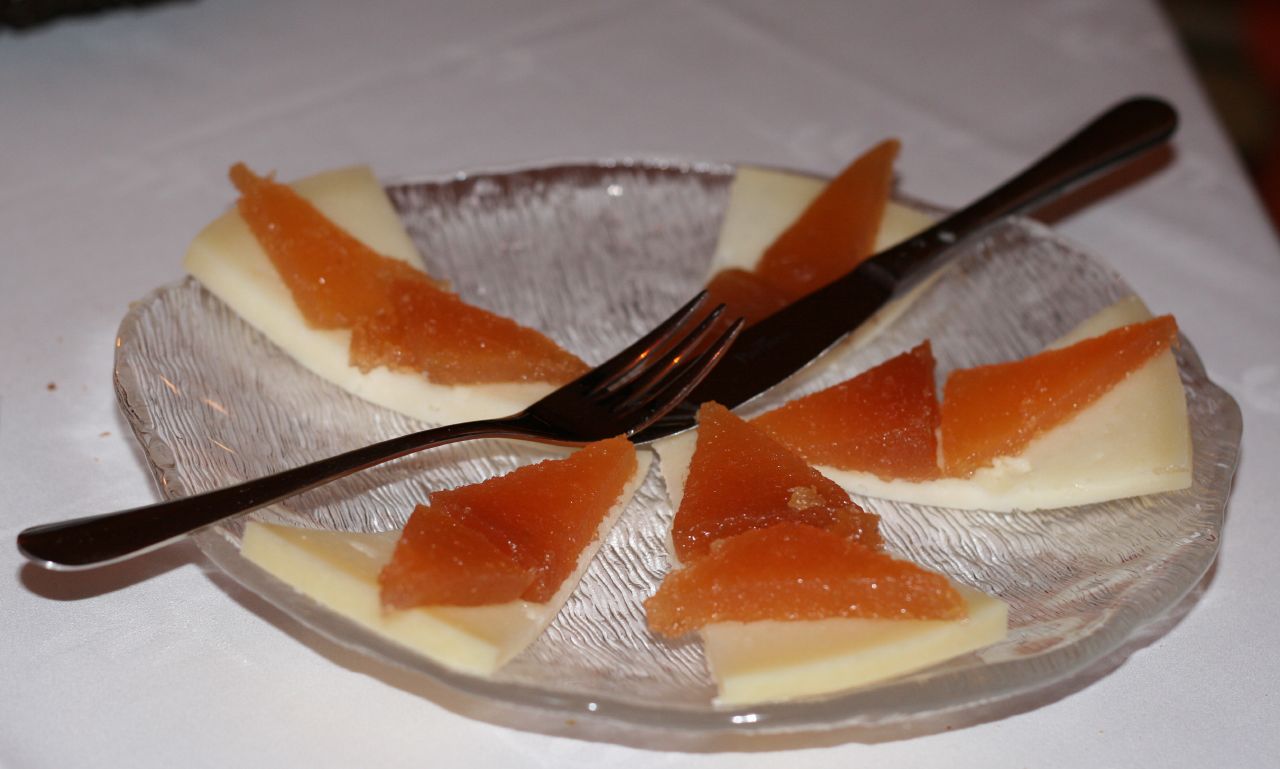
Manchego con membrillo / Dulce de Membrillo / Quince paste / Küdooniamarmelaad

I made a large batch of the quince paste, Dulce de Membrillo, last week. I used the same same old recipe that I've used previously and really liked the result. Rather conveniently, one local speciality store had a 9-month old Manchego cheese on offer last week, so we got to sample plenty of Membrillo the way you're supposed to - a slice of salty and crumbly Manchego cheese with a slice of sweet and sticky Membrillo paste (aka Manchego con Membrillo).

Highly recommended.

Manchego con membrillo / Dulce de Membrillo / Quince paste / Küdooniamarmelaad

Eestikeelne küdooniamarmelaadi retsept on siin. Küdooniad ehk aivad on müügil suurematel turgudel (nt Tallinna Keskturg).
reade more... Résuméabuiyad

Playing Russian roulette with Pimientos de Padrón or green Padrón chiles

Padron Roulette :)

I addition to all those lovely tomatoes, we've got a pretty good crop of Padrón peppers (Pimientos de Padrón) and various aubergines/eggplants from our greenhouse. Last weekend we met up with some friends and roasted some of the green chiles, then drizzled them with olive oil and sprinkled sea salt flakes on top. It's a popular tapas-dish in Spain, and the added excitement is that while most of this green chillies are rather mild, then about one in ten is fiery hot (hence the nick-name "Russian roulette peppers").

When I first had these at Johanna's place couple of years ago, I didn't encounter a single hot one. Now we didn't have any mild ones - they were all oh-so-hot! Not such a roulette after all :D This can be explained by the timing - we visited Johanna in April (early in the season), and now ate our own crop in August (late in the season) - young and new Padrońs are generally mild, and 'old' ones hot.

Padrón Chillies are originally from Mexico, but are named after a town in Galicia, Spain, where they first started to cultivate these chillies in Europe.
reade more... Résuméabuiyad

Dulce de Membrillo or a delicious quince paste to go with cheese

Dulce de Membrillo / Quince paste / Küdooniamarmelaad

I know there are several beautiful Membrillo-posts out there (f.ex. written by Melissa, Elise, Nicky, Aran, Pastry Studio - to name just a few), but I used a somewhat different method to make this delicious Spanish quince paste, so it's worth sharing the recipe after all. We were served the Queso con Membrillo on several occasions during our trip to Spain in Spring 2008 (for example, here's a plate we enjoyed at Rincón del Chorro, Albarracin, Aragon), and I've made the quince paste twice at home since then. Quinces are only available at the markets here during early Winter, and not widely familiar to people at all.

Beautiful quinces / Aiva ehk küdoonia

By the way - if you've got small children at home, then try serving them some of the puréed quince before adding the sugar. Our daughter LOVED the unsweetened quince pureé!!

Quince Paste
(Küdooniamarmelaad 'Dulce de Membrillo')

Dulce de Membrillo / Quince paste / Küdooniamarmelaad

6 large quinces (about 1,5 kg)
water
about 1 kg caster sugar
lemon juice

Wash the quinces and place into a large saucepan. Pour over enough water to cover the fruit. Bring to boil and simmer on low heat for about 1-1,5 hours, until the quinces are completely soft (test for softness by piercing with a small knife).
Remove the saucepan from the heat and let cool.
Remove the soft quinces from the cooking liquid. Cut into half, remove the core. NOTE: I did not peel the quinces. A lot of the pectin is in the peel (it's the pectin that helps the paste to thicken and jellify later), and as quinces are hard to grow commercially, it's unlikely that they've been sprayed with something horrible anyway. Feel free to peel the quinces if you prefer, of course.
Place the quinces into blender and pureé until smooth (add a spoonful or few of the cooking liquid to get you started, if needed).
Now weigh the cream-coloured fruit pulp and place into a clean saucepan. Add the same amount (re: weight) of sugar, and a squeeze or two of lemon juice. (I believe that the acid in lemon juice works with the sugar to jell the pectin in quinces).
Bring slowly to the boil and then simmer over moderate heat, stirring regularly, until the quince paste thickens, turns darker in colour and doesn't stick to the walls of the saucepan any longer (this can take about an hour).
Line a heat-resistant dish with parchment paper and pour the quince paste into the dish (mine was 25 x 35 cm). Smooth the top, and place into a dry and cool place to cool and jell completely.
Cut into thick slices and serve with Manchego cheese (or Nopri talojuust, if you're reading and making this in Estonia.).
reade more... Résuméabuiyad

Empanada Gallega de Atun


Ever since I enjoyed my first tuna-filled Galician turnover, empanada gallega, on a hillside picnic about an hour's drive from Madrid last Spring - in a lovely company of Ximena and her hubby J - I've been wanting to make these at home. I have been waiting for Ximena's special recipe to appear on Lobstersquad (soon!), but meanwhile I came up with this version of the famous Spanish pastry. I must admit I was thoroughly satisfied with the result - and I hope that my Spanish friends approve.

Basically, it's a yeast pastry (tinged slightly red with the help of the very special and wonderful smoked Spanish paprika powder, Pimentón de la Vera) that's encasing a moist and flavoursome tuna, egg and tomato filling. Although we had small turnovers on that memorable hillside picnic - empanadillas gallegas - then it's more traditional to make one large pie that's cut into wedges.

Empanada Gallega de Atun or Galician Tuna Pie
(Galiitsia tuunikalapirukas)
Serves six to eight


Yeast pastry:
500 g plain flour
300 ml warm water (42 C)
100 g olive oil
1 sachet of active dry yeast
1 tsp smoked mild Spanish paprika (Pimentón de la Vera, dulce)
1 tsp salt

Filling:
2 cans of tuna chunks in brine (a 200 g), drained and flaked
3 Tbsp olive oil
2 large onions, chopped
1 green bell pepper, chopped
200 g chopped tomatoes (half a regular can)
2 garlic cloves, chopped
2 hard-boiled eggs, peeled and chopped
a handful of chopped fresh parsley
salt, black pepper and smoked paprika powder, to taste

For brushing:
egg

First, prepare the yeast dough. Mix flour, active dry yeast, paprika powder and salt in the mixing bowl. Stir in the water and oil and mix and knead until a uniform ball forms. (I use my KA mixer for this). Cover with clingfilm or a clean kitchen towel and leave to rise in a warm place for an hour.
For the filling, you start with sofrito. Heat olive oil on a sauté pan, add onion and bell pepper and sauté for a few minutes. Add garlic, sauté for another few minutes. Then add the tomatoes, season with salt and pepper. Simmer on a low heat for about 10 minutes, until the vegetables are soft and the sauce has thickened a little.
Season with smoked paprika powder, salt and pepper to taste. Stir in drained and flaked tuna, chopped hard-boiled eggs and parsley.
Divide the yeast pastry into two more or less equal pieces. Dust your worktop with some flour and using the rolling pin, roll one piece into a large circle, about 5 mm thick. Transfer onto a baking sheet lined with parchment paper.
Spread the tuna, egg and tomato filling on top, leaving about 2 cm edge.
Roll out the other half of the pastry, place that over the filling. Crimp the edges together (see below).
Using a sharp small knife, cut couple of "breathing holes" on top of the pastry.
Brush with a whisked egg.
Bake in the middle of pre-heated 200 C oven for about 30 minutes, until the empanada is lovely golden brown on top.
Remove from the oven and leave to cool a little before cutting into wedges and serving.

reade more... Résuméabuiyad

An orange and fennel salad recipe


Looking for a light, quick and festive starter? Well, try this one :) It's a lovely Italian winter salad (Sicilian in origin, apparently), where fennel provides a lovely and slightly aniseedy crunch, orange provides the necessary sweet note, onion the sharpness and toasted walnuts add textural interest.

Orange and fennel salad
(Apelsini ja apteegitilli salat)
Serves 4

large handful or two of salad leaves (f.ex. lamb's lettuce)
1-2 fennel bulbs, trimmed and thinly sliced
1 red onion, peeled and thinly sliced
6 medium-sized (red blood) oranges, peeled and thinly sliced
sea salt
freshly ground black pepper
extra virgin olive oil
walnut halves, toasted

Peel the oranges (remove as much of the white pith as possible) and cut crosswise into thin slices.
Remove the hard bottom part of the fennel bulbs and discard, cut the fennel into thin slices.
Peel the red onion, cut into thin slices.
Place orange, fennel and onion slices into a large bowl, season with salt and pepper and drizzle with olive oil. Leave to stand for at least 30 minutes or up to a few hours at room temperature, mixing couple of times.
To serve, place some salad leaves (cos or lamb's lettuce) onto a serving plate, top with salad, including any juices.
Garnish with toasted chopped walnuts.
reade more... Résuméabuiyad